Published on 14 April 2026 by Josh Grossman
Update — 16 June 2026: AGHAST has since been donated to OWASP and is now OWASP AGHAST. See AGHAST is now an OWASP project for the full story. The project now lives at aghast.owasp.org, the code is at
owasp-aghast/aghast, and it installs as@owasp-aghast/aghast. The repository link below has been updated to point to its new home.
tl;dr
Today, we are releasing AGHAST, an open source framework that combines static discovery with AI prompts to find code-specific and company-specific security issues.

If you want to try it out, you can find information here in the Github repository.
Here is a brief video introduction:
If you want to understand more about the background, read on!
Introduction
Every security team has asked some version of this question: “Can our scanner check for that?” Usually, the answer is no - or at best, “it’s complicated.” That frustration is exactly where this story begins.

The Gap in Generic Scanning
A couple of years ago, we started thinking about a particular problem in application security. There were loads of generic code scanning tools that would tell you about basic technical vulnerabilities, things like SQLi, XSS, the usual suspects. But what if we wanted to find something that was code-specific or company-specific?
Some of the scanning tools provide a custom rules mechanism, which is often very complicated. It was not until Semgrep came about that a powerful but simple way of writing custom code scanning rules was available.
The Questions Nobody Else Could Answer
The sorts of questions we wanted to answer were:
- Has this custom business verification been implemented correctly?
- Has the company’s custom authorization mechanism been used correctly and consistently?
- Are API endpoints returning too wide a data set?
These are questions that are specific to a codebase or organization, and basically impossible for generic static security scanners to answer. They require context to understand how things should work, not just what is technically vulnerable.

From Research to Real-World Use
Working with Michal Kamensky, we delivered a talk and eventually a training course focused around this area of custom tests. The research initially focused on static testing, and for the training course also included dynamic testing.
The aim was simple: provide a straightforward way to get an answer to a codebase-specific or company-specific question.
We also started using this mechanism with clients to secure their codebases. However, the simplicity was sometimes a drawback. Diagnosing certain problems could be very complex or even impossible for a static rule alone to establish.
Something was missing. Static rules could get us part of the way but were not good enough for every circumstance.
Enter LLMs
Thankfully at this point, LLMs came to the rescue. Suddenly we had LLMs and coding agents that were very good at understanding and interpreting code.
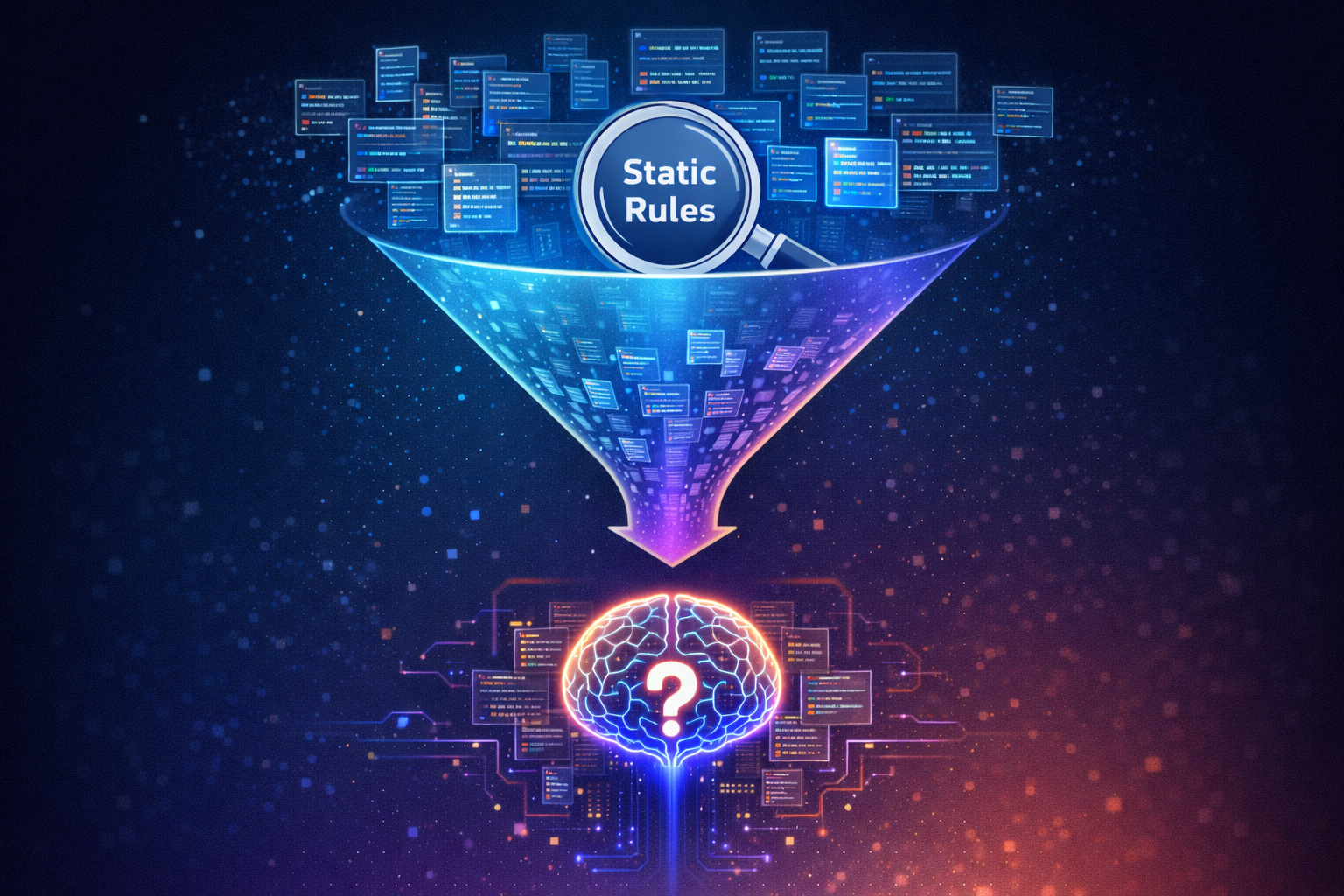
We started by moving from static rules to LLM prompts and quickly discovered that once you reached a certain codebase size, the results became unreliable. Feeding an entire codebase to an LLM and asking “find the problems” is a bit like asking someone to proofread the internet: technically possible, practically useless.
That led to a key realization: why not combine these two techniques?
- Use static rules to narrow down to particular areas of the codebase.
- Use an AI prompt to investigate that specific area in depth.
Think of it as a metal detector on a beach: the static rule tells you where to dig, and the AI carefully examines what you find.
The Orchestration Problem
That approach works conceptually, but it introduces another challenge:
How do you orchestrate this at scale, in a repeatable way, and in a way that integrates with existing processes?
Running a one-off combination of a Semgrep rule plus an LLM prompt is one thing. Doing it consistently across multiple codebases, in CI pipelines, with structured output requires slightly more plumbing.
The Answer: AGHAST
The answer is AGHAST.
This is a framework that has been germinating for about six months.
AGHAST stands for AI-Guided Hybrid Application Static Testing, and it allows us to orchestrate tests based on this custom test philosophy.
Today, we at Bounce Security are open sourcing this tool for you to use and build on as well.
What AGHAST Does
AGHAST helps you run three types of checks:
- Pure AI scanning rules - let the LLM do all the analysis
- A combination of a static mechanism and an AI scanning rule - the sweet spot for most use cases
- Purely static rules - for completeness, when a traditional static rule is all you need
The beauty of the approach is what you don’t need:
- You don’t need to modify the code
- You don’t need to build something into the codebase
- You don’t need to write code in the language of the codebase
All you need is:
- Access to the codebase
- An understanding of the problem you are trying to discover
- The ability to write some simple rules
There are almost certainly other ways of achieving this, but to our mind, this approach is straightforward, deterministic, and very powerful.
Built for the Real World
Aside from the basic function, there are several features designed to make AGHAST easy to use and integrate into your existing workflow.
1. CI Pipeline Integration
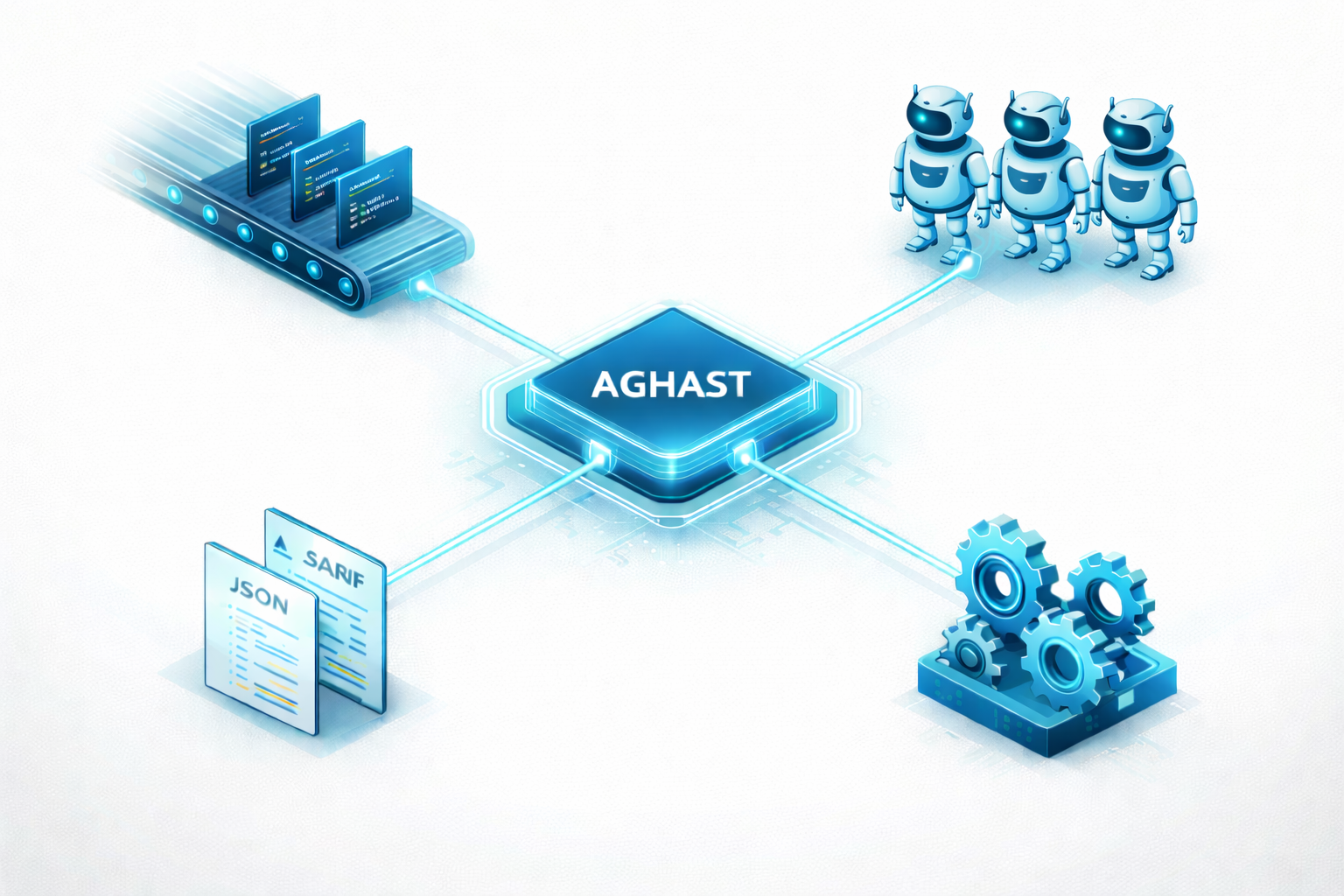
From the beginning, AGHAST was designed to work easily within automated CI pipelines, utilizing a simple install process, text based configuration and a single CLI call to run.
We anticipate that most teams will find it most useful in this context in the long run. Set it up once, and it runs with every build.
2. Pluggable Components
The current implementation uses Claude Code and the Claude Agent SDK for AI analysis, and Semgrep Community Edition for static scanning.
However, the design intentionally allows for pluggability across the stack:
- Different LLM and API providers
- Different SAST engines (e.g., OpenGrep or other static discovery mechanisms)
- Language agnostic by design
No vendor lock-in here - use whatever works best for your team.
3. Pluggable Outputs and Actions
Output formats are designed to be pluggable - currently supporting JSON and SARIF, with other formats straightforward to add.
Beyond output formats, the platform could also be extended to support pluggable actions, enabling integration with ticketing systems, notifications, or other downstream workflows.
4. Flexible Configuration Mechanism
AGHAST includes a flexible configuration mechanism.
This allows checks to be specified in multiple ways:
- Per-codebase configuration - tailor checks to individual projects
- Central configuration containing definitions for multiple codebases - manage everything from one place
This makes it easy to define a CI job in one place using a single configuration file, which can then apply across multiple codebases that use the same CI job.
Protection of our work
We want AGHAST to be widely available, whether you are a practitioner using it in your own environment, or a consultant implementing it for clients.
AGHAST is licensed under AGPL to keep it open and ensure improvements flow back to the community. If you are interested in commercial licensing, professional support, or help implementing AGHAST in your organization, get in touch.
Prior and Parallel Work
No tool exists in a vacuum. We want to acknowledge some prior and parallel work in this area that both inspired and validated the direction we took.
Semgrep

Firstly, we want to give a shout out to the team at Semgrep, Inc for building a fantastic tool for simple static scanning. They truly revolutionized this space and we stand on their shoulders as do many others.
Semgrep Community Edition is a key part of AGHAST today, although the system is also extensible and could support OpenGrep or other static discovery mechanisms.
Anthropic Code Security (et al)
A few weeks ago, Anthropic released their code security product to much fanfare (and gnashing of shareholder teeth) followed by similar releases from other LLM providers.
That product appears to focus on giving an LLM a codebase and seeing what vulnerabilities emerge.
AGHAST differs in a key way:
- Those tools are exploratory - “tell me what you find”
- AGHAST is goal-driven - “tell me about this specific thing”
AGHAST looks for specific issues you define and returns a specific, well-formed answer about those issues.
RAPTOR
⠀⠀⠀⠀⠀⠀⠀⠀⠀⠀⠀⠀⠀⠀⠀⠀⠀⠀⠀⠀⠀⢀⣠⣤⣤⣀⣀
⠀⠀⠀⠀⠀⠀⠀⠀⠀⠀⠀⠀⠀⠀⠀⠀⠀⠀⠀⠀⠀⣾⣿⣿⠿⠿⠟
⠀⠀⠀⠀⠀⠀⠀⠀⢀⣀⣀⣀⣀⣀⣀⣤⣴⣶⣶⣶⣤⣿⡿⠁⠀⠀⠀
⣀⠤⠴⠒⠒⠛⠛⠛⠛⠛⠿⢿⣿⣿⣿⣿⣿⣿⣿⣿⣿⠟⠁⠀⠀⠀⠀
⠀⠀⠀⠀⠀⠀⠀⠀⠀⠀⠀⠀⠀⠉⠛⣿⣿⣿⡟⠻⢿⡀⠀⠀⠀⠀⠀
⠀⠀⠀⠀⠀⠀⠀⠀⠀⠀⠀⠀⠀⢀⣾⢿⣿⠟⠀⠸⣊⡽⠀⠀⠀⠀⠀
⠀⠀⠀⠀⠀⠀⠀⠀⠀⠀⠀⠀⠀⢸⡇⣿⡁⠀⠀⠀⠉⠁⠀⠀⠀⠀⠀
⠀⠀⠀⠀⠀⠀⠀⠀⠀⠀⠀⠀⠀⠈⠻⠿⣿⣧⠀ Get them bugs.....⠀⠀⠀⠀⠀⠀⠀⠀
(We had to reproduce their funky ASCII art)
At the start of the year, our friends Gadi Evron, Daniel Cuthbert and others released RAPTOR, which performs agentic code scanning for various scenarios.
It is particularly strong for offensive work and moving from vulnerability discovery to exploitation.
While we initially considered building on Raptor, the design philosophy differs enough that it ultimately made more sense to build separately.
OpenAnt
More recently, Gadi Evron and team released OpenAnt. We saw it about a week before release and thought their approach for focusing the LLM’s attention on particular areas of code at a time was super interesting.
The key difference again is that AGHAST is oriented around specific checks and explicit criteria that determine which parts of the codebase are examined. That said, we liked the OpenAnt approach enough that AGHAST now supports OpenAnt datasets as an input source. This means you can use OpenAnt as a discovery method for targeted checks, feeding pre-extracted code units with call graph context into AGHAST’s AI analysis pipeline.
It was encouraging to see them independently arrive at the same conclusion:
A key differentiator for LLM-based analysis is guiding the model to the specific area of the codebase it should examine rather than trying to load a whole codebase into context.
What Comes Next
We think tools like AGHAST are going to be an important step in taking static code analysis to the next level of usability and accuracy. The combination of deterministic static rules and intelligent AI analysis opens up possibilities that neither approach could achieve alone.
We are looking forward to seeing your feedback - and even more, to seeing what custom checks you build with it!